
Guide: Will Turnitin Detect If I Use the Wrong Citation

In a Reddit post, A student shared concern that Turnitin might flag their thesis for citing a paper that doesn’t match their claim.
Turnitin focuses on similarity and plagiarism, not whether your references are accurate or relevant.
Understanding this distinction can help you feel more in control of your submission.
Next, we’ll look at a quick answer to whether Turnitin flags incorrect citations and how that affects your similarity report.
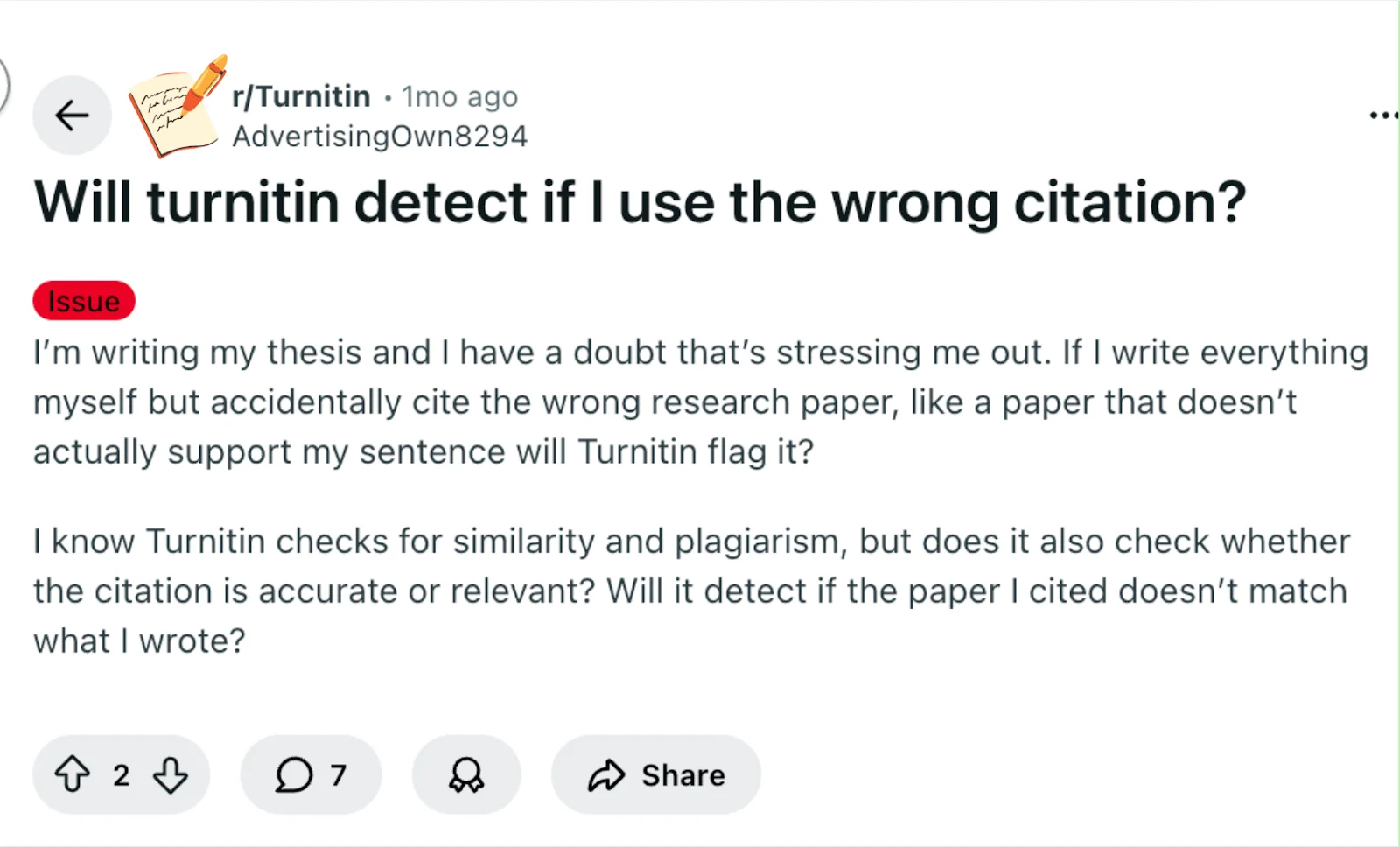
Quick Answer: Will Turnitin Flag Wrong Citations?
No—Turnitin does not directly check whether a citation is accurate or supports your claim. Its main function is to analyze text similarity, not the correctness or relevance of references.
Turnitin compares the wording in your paper with its database of student submissions, academic publications, and web content. If your text matches existing sources, it may appear in the Turnitin Similarity Report, even if a citation is included.
However, Turnitin does not verify whether the source you cited actually supports your statement. That type of evaluation is usually done by instructors or thesis reviewers, who read the cited source and check whether it is relevant.
In short:
Turnitin does not verify citation accuracy
It mainly detects text similarity
Incorrect or unrelated citations are usually identified by human reviewers, not the software.
Key Turnitin Concepts You Need for This Question
Understanding why Turnitin won’t flag wrong or inaccurate citations starts with knowing how the tool works.
Turnitin compares the text of your submission against a large database of sources rather than evaluating whether your sources are correct.
Here are the key concepts that matter for this question:
Similarity Score: This percentage shows how much of your text matches existing sources.
It focuses entirely on matching phrases, sentences, or paragraphs, not on whether your citations accurately support your points.
Even if a paper is cited incorrectly, it won’t change your similarity score.
Match Overview / Match List: Turnitin breaks down matched text into a detailed report, showing where the overlaps occur.

References may appear here if they match text from other student submissions or publications.
However, a mismatch between your argument and a cited source won’t be highlighted, because the tool only flags identical or highly similar text.
Repository: Turnitin stores student papers, published articles, and other sources in its database.
When you submit a paper, Turnitin checks for overlaps with these stored works.The repository helps detect copied text but doesn’t check whether the source cited actually supports your statement.
Exclusion Settings: Instructors can adjust settings to exclude bibliographies, quotes, or small matches from the similarity report.
This can affect whether your references appear in the report, but it still won’t detect incorrect citations.
Originality Report: This report summarizes matches, providing an overall similarity score and links to matching sources.
It’s a useful guide to where text overlaps, but it cannot verify that citations are accurate or relevant.
Knowing these terms clarifies why Turnitin focuses on textual similarity rather than citation correctness.
While it can highlight copied content or improper paraphrasing, human review is necessary to catch citation mistakes, which is why professors may still notice an incorrect reference even if Turnitin does not.
Why Professors Might Notice Wrong Citations
Even though Turnitin focuses on text similarity, professors often evaluate citations more closely.
They’re usually familiar with key papers in their field, so a citation that doesn’t match your argument can stand out immediately.
This isn’t about plagiarism detection—it’s about whether your references actually support your points.
Incorrect citations can affect credibility. If a paper is cited incorrectly, it may suggest a lack of careful reading or understanding, which could influence your grade or your professor’s trust in your research.
Even small errors can attract attention, especially in fields where certain studies are widely known.
Some practical signs professors might notice include:
Citing a paper that clearly contradicts your statement.
Using a source that doesn’t appear relevant to your argument.
Repeatedly citing sources incorrectly across multiple sections.
How closely a professor checks references can vary depending on class size or assignment length.
In larger classes, minor mistakes may be overlooked, but in these or major papers, even subtle citation errors can be significant.
Recognizing this helps you understand why verifying each reference is important and why human review remains crucial.
How to Handle Citation Accuracy in Turnitin Reports
Since Turnitin won’t flag whether your citations are correct, the responsibility falls on you to ensure accuracy.
Reviewing your references carefully is the most effective way to avoid problems with both similarity reports and academic credibility.
Start by double-checking that each source actually supports the statement it’s attached to. Make sure the details—like author names, publication year, and page numbers—are correct.
Using reference management tools, such as Zotero, EndNote, or Mendeley, can make this process faster and reduce human error.
Turnitin reports can still help indirectly. Reviewing your similarity report allows you to see if references match text from other papers, which can indicate potential overlaps or mistakes in citation formatting.
Some instructor settings may let you exclude references or resubmit corrected drafts, but these depend on your institution.
The key is treating Turnitin as a tool for spotting text matches, not citation verification.
By combining careful manual checks with your similarity report, you can minimize errors and reduce stress about whether your citations might cause issues.
Bonus Tip: Use A Reliable Turnitin Detector
If you want extra confidence before submitting your paper, Turnitindetector can help you check for text similarity and AI content. This tool provides a quick and easy way to review your work, ensuring it meets academic standards before your final submission.

With Turnitindetector, you can:
Check Similarity – Get a detailed similarity report to identify any areas of your paper that may be too similar to other sources, helping you revise before submitting.
Turnitin AI Detector – Detect AI-generated content to ensure that your work is original and in line with academic integrity.
No Submission Risk – Your paper is not stored in any database, so it won’t affect your final submission score or be flagged in any official Turnitin report.
Quick Results – Turnitindetector provides fast results, allowing you to address any issues promptly without the worry of running out of time.
By using Turnitindetector, you can submit your paper with confidence, knowing that it’s fully checked for both similarity and AI content.
FAQ
Does Turnitin detect AI?
Yes, Turnitin can detect AI patterns commonly associated with AI-generated content through its AI detection feature.
Does Turnitin detect ChatGPT?
Turnitin does not specifically detect ChatGPT. It doesn't label content as generated by any specific AI tool, but it looks for statistical patterns often seen in AI writing.
How does Turnitin detect AI?
AI detection in Turnitin works by analyzing writing patterns, such as sentence predictability and structural consistency, which are commonly found in AI-generated texts across various tools.
Conclusion:
If you cite the wrong paper in your thesis, Turnitin likely won’t flag it because it focuses on similarity, not accuracy.
However, professors may notice errors, so double-checking your references is the safest way to avoid academic issues.
Using reference management tools and reviewing your similarity report can help catch mistakes before submission. I get why this feels stressful, but focusing on citation accuracy and careful review is the most practical step to protect your work and peace of mind.