
Is It Safe to Use Turnitin AI Checker on Discord Forums?

A student in an online forum asked whether it was safe to send a paper to someone on Discord who claimed they could run a Turnitin AI check.
That concern is reasonable. When a draft leaves your own device or school system, you have to think about privacy, document storage, result accuracy, and academic integrity rules before you share it.
The safer choice is to understand what a third-party checker can and cannot verify before handing over a full draft.
Here is the practical answer to the question: is it safe to use a Discord-based Turnitin AI checker where someone checks it for you?
Quick Answer to “Is It Safe to Use a Third-Party Turnitin AI Checker?”
If you are relying on a Discord forum or a stranger who says they can check your paper with Turnitin AI, the safer answer is no. You may receive a screenshot or score, but you also give up control of your draft.
Direct Answer
It depends less on the promise and more on who handles your file, where it is uploaded, and whether the report source can be trusted.
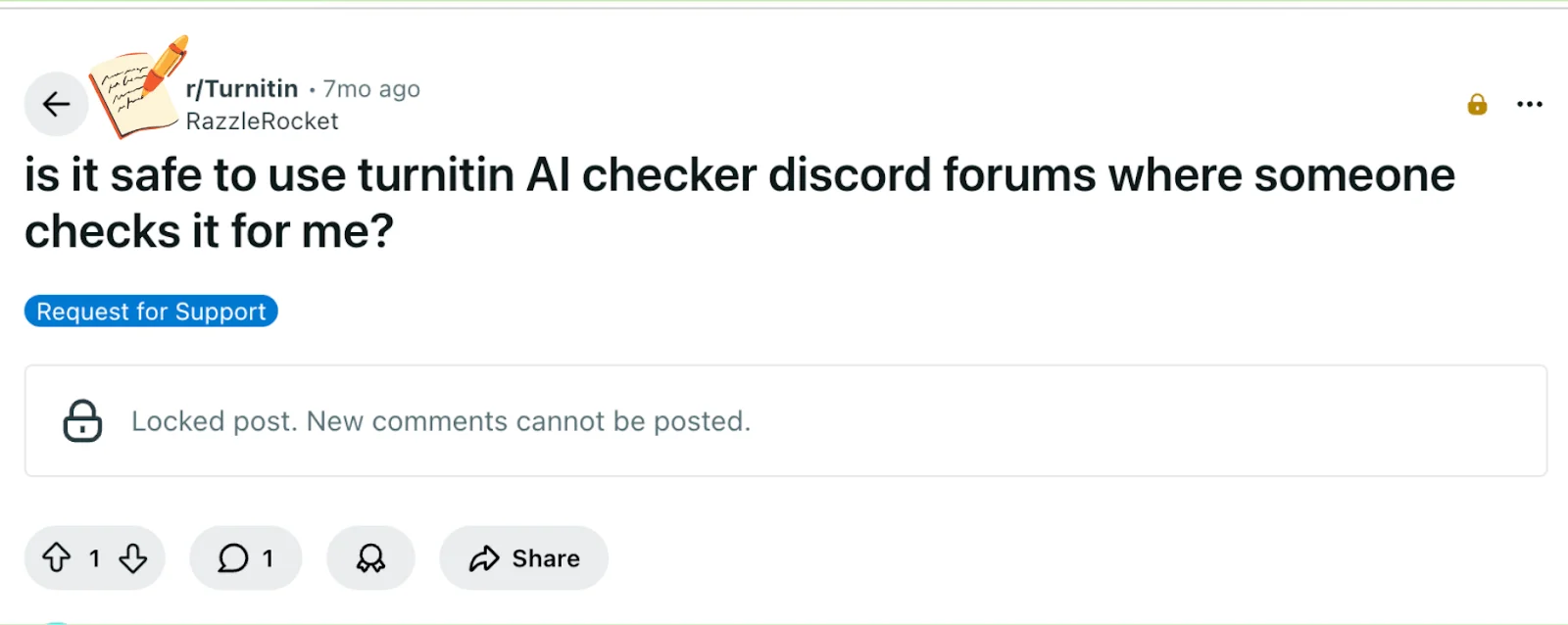
Sharing your draft on an open or semi-private platform can expose original writing, personal details, research notes, and assignment information. That creates privacy concerns and may raise academic integrity questions if your school limits outside checking.
If you need a Turnitin-style AI or similarity review, use a transparent report service or a school-approved option instead of sending the file to an unknown person.
TL;DR Bullets
Sharing your draft with strangers can risk privacy breaches.
Unknown AI checkers may provide inaccurate results.
For Turnitin AI checks without your class ID, choose trusted tools — safer than Discord-based checks.
This answer gives you an overview, but to understand why, it helps to review some Turnitin basics first.
Key Turnitin Concepts You Need for This Question
Understanding how Turnitin-style checks work helps explain why a Discord offer can be risky. Focus on four concepts: repository storage, similarity score, AI indicators, and assignment settings.
1. Repository
Turnitin stores submitted papers in a Turnitin repository, which allows it to compare your text against millions of academic sources, previously submitted papers, and online content.
When an unknown service handles your file outside your school workflow, you may not know where the draft goes or whether its similarity result is based on a comparable source set.
2. Similarity Score
A similarity score is the percentage of text that matches sources included in the comparison. It is a signal for review, not an automatic plagiarism judgment.

A real similarity report includes matched source details and exclusions that can change how the percentage should be interpreted. A screenshot from a stranger may not show enough context to guide safe revision.
3. AI Detection
Some Turnitin setups include AI writing indicators that estimate whether sections may resemble AI-generated text. These indicators should be read carefully because AI detection can involve uncertainty.
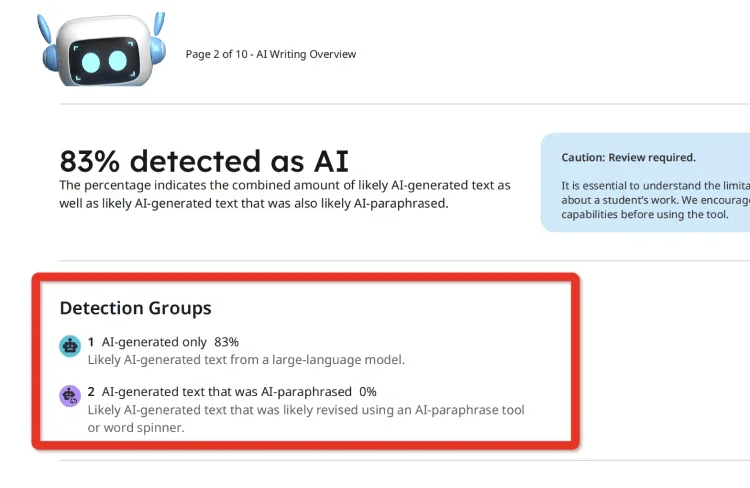
A third-party score can still be useful only if the report source is transparent. If the person cannot explain what report was generated or how your file is handled, treat the result as unreliable.
4. Submission Settings
Turnitin submissions can be configured differently depending on assignment requirements. Options like excluding quotes or bibliographies, ignoring small matches, and updating similarity reports are controlled by your institution.
A Discord checker will not know every setting your course uses, so its result may differ from the report your instructor reviews.
These details explain why sending a draft to someone else can create more risk than clarity. The score may be incomplete, the file may be stored, and the report may not match your assignment setup.
Understanding these mechanics helps you make safer choices about AI checking and similarity detection.
Risks of Using Third-Party Turnitin AI Checkers
Knowing how Turnitin works makes it easier to see why third-party AI checkers, like those on Discord, can be risky. When someone else handles your paper, you lose control over both privacy and accuracy.
Sharing your draft with strangers can expose sensitive content. Your paper could be copied, stored, or even reused without your permission, which may create unintended consequences.
Accuracy is another concern: third-party tools often lack access to Turnitin’s repository and official AI detection algorithms, so similarity scores or AI flags may be misleading.
This can give you false reassurance—or worse, make you think your paper is safe when it’s not.
Using unofficial checkers may also create issues with academic integrity. If your institution finds out that your draft was processed externally, it could be seen as a violation, depending on your school’s rules.
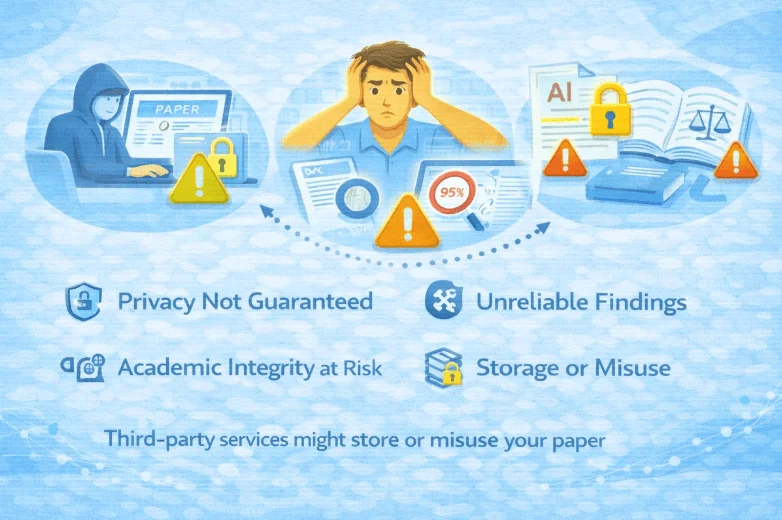
Privacy of your draft can be uncertain.
Similarity and AI detection results may be unreliable.
Academic integrity could be at risk.
Third-party services might store or misuse your paper.
Recognizing these risks helps you understand why safer alternatives are worth considering and why relying on Discord or other unofficial services can increase stress rather than reduce it.
Safer Alternatives to Turnitin AI Checkers
Since using unknown Turnitin AI checkers carries privacy and accuracy risks, there are safer ways to review your work. The key is to keep control over your draft while still getting reliable feedback.
One of the safest options is using official Turnitin portals provided by your school. These submissions stay within the institution’s secure system, and any similarity or AI detection results reflect what your instructor will actually see.
Some universities also offer internal tools for AI or plagiarism detection, which are safe to use and often integrated with your assignments.
If official tools aren’t available, carefully selected online AI checkers can provide rough guidance—but always check their privacy policies first. Avoid services that require you to hand over your full draft to strangers.
Manual review is another effective alternative. Revising your work for clarity, proper citations, and originality reduces AI detection flags and improves overall quality.
Stick to official or institution-approved tools.
Check privacy policies of any online service.
Revise and review your own work carefully.
Choosing these alternatives helps you protect your paper, avoid inaccurate results, and reduce anxiety about academic integrity.
Bonus Tip: Use Turnitindetector to Check Your Paper
If you cannot access a full report through your school and do not want to send your draft to a stranger on Discord, T-detector can be a safer way to review possible similarity and AI-writing issues before submission.
A reliable Turnitin AI detector, like Turnitindetector, can:
Provide a Similarity Report – Review matched sections, source context, and areas that may need citation or paraphrasing fixes.
Show AI Report Signals – Review sections that may read as AI-like so you can decide whether they need clearer, more personal revision.
Avoid Database Storage Risk – Your paper is not added to Turnitin's database, so checking it through T-detector will not create a later 100% similarity match because of repository storage.

Conclusion
If someone on Discord offers to check your paper with a Turnitin AI checker, treat it as risky unless you can verify the report source, privacy terms, and file-handling process.
The biggest concerns are document privacy, unreliable scores, unclear storage, and possible conflicts with your school's academic integrity expectations.
Use official school access when you have it. If you do not, choose a transparent report option and review the results as revision guidance, not as a promised outcome.
Keeping control of your draft is the most practical way to reduce stress before submission and protect your work.