
Why Does Turnitin Flag 51% AI After Removing Images?

In a Reddit post, a student shared that their essay showed 0% AI with images, but 51% AI once the images were removed, even though the text stayed exactly the same.
That confusion is common, and it doesn’t mean you did something wrong.
To make sense of it, let’s start with a clear, practical answer to what’s likely happening behind the scenes.

Quick Answer to why removing images changed the AI score
The key takeaway so far is that nothing about your wording changed, yet Turnitin’s AI indicator did—so the explanation has to do with how Turnitin analyzes submissions, not what you wrote.
Direct Answer
Turnitin’s AI detection focuses on text patterns, not images, but images can still affect how the text is processed.
Does Turnitin detects AI graphics? No.
When images are present, they can break up text, change spacing, or alter how the system segments your writing.
Once those images are removed, the same text may be reanalyzed as a denser, more continuous block, which can trigger different AI pattern signals.
Turnitin doesn’t publicly explain its exact scoring logic, so the percentage shift can feel abrupt and opaque.
TL;DR Bullets
You didn’t change the words, but the text layout changed
Turnitin AI detection looks at text structure and patterns
Removing images can make writing look more uniform to the system
A higher AI percentage doesn’t automatically mean AI was used
Understanding that the score can change without text edits raises a bigger question: what exactly does Turnitin look at when it generates an AI report?
Key Turnitin Concepts You Need for This Question
To understand why removing images changed your AI score, it helps to know what Turnitin’s AI indicator is—and what it isn’t.
First, Turnitin’s AI indicator is probabilistic, not definitive. It estimates how closely your text resembles patterns commonly produced by AI models.
It does not confirm authorship, intent, or misconduct. That’s why two submissions with the same words can still receive different percentages.
Second, Turnitin analyzes text only, not images themselves. Diagrams, screenshots, and other visuals aren’t evaluated for AI use.
However, they can still affect analysis indirectly. When images are present, they break up paragraphs, reduce continuous text blocks, and change how the system segments sentences.
Once images are removed, Turnitin may reassess the text as a more uniform, uninterrupted body, which can shift pattern detection results.
Another key concept is submission reprocessing. Each upload is treated as a fresh submission.
Even small structural changes—like removing images, altering spacing, or changing file layout—can cause Turnitin to re-tokenize and re-weight the text during analysis. That reprocessing alone can lead to noticeable score fluctuations.
Finally, the AI percentage is not contextualized by default. The report doesn’t explain why a score is high or low, and the exact scoring model is not publicly disclosed.
How that number is interpreted depends on your institution and assignment settings, and often on instructor judgment rather than the raw percentage alone.
Taken together, these concepts explain how a formatting-only change—like deleting images—can realistically produce a large AI score shift without any change in wording.
How Images Can Change a Turnitin AI Report Without Changing Text
Once you know that Turnitin’s AI detector focuses on text patterns, it becomes easier to see why images can still make a difference. Images themselves aren’t evaluated for AI use, but they do change how your text is presented to the system.
When images like diagrams or screenshots are included, they interrupt the flow of writing. Paragraphs may be shorter, sentences are spaced out, and the overall structure looks less uniform.
That variation can reduce how strongly the text matches patterns the AI model associates with machine-generated writing.
When you remove those images, the same words may be reprocessed as longer, uninterrupted blocks of text.
The writing can suddenly appear more consistent in tone, rhythm, and sentence length. For an AI detector, that uniformity can increase the likelihood score, even though nothing about your actual writing process changed.
This is why the AI percentage can jump dramatically after a formatting-only edit. It reflects how the system re-reads the text, not new evidence that the content was generated by AI.
What a 51% Turnitin AI Score Does—and Doesn’t—Mean
Seeing a 51% AI score can feel alarming, especially after a previous 0%, but it’s important to understand what that number represents.
Turnitin’s AI indicator estimates the likelihood that text resembles AI-generated patterns, not whether it was actually written by AI. It is a probabilistic signal, not a proof of misconduct.
A few points to keep in mind:
The score doesn’t measure intent or authorship—it only analyzes text structure and style.
Changes in formatting, sentence flow, or spacing (like removing images) can shift the AI percentage significantly.
Instructors often consider the context of your writing, drafts, and explanations, rather than relying solely on the AI score.
What it does do is signal areas where the system detected patterns commonly found in AI writing. What it doesn’t do is confirm that your essay was generated by AI or that you did anything wrong.
Understanding this distinction helps reduce unnecessary stress. Instead of panicking over the number, focus on what it actually tells you about text patterns and how you might document your writing process if needed.
What You Can Do Now Based on Your Turnitin Submission
Now that you understand why the AI score jumped, the next step is focusing on practical actions to stay prepared and calm.
Even though the number may feel alarming, you don’t need to panic if your work is entirely your own.
Start by keeping drafts and notes that show your writing process. These can be useful if your instructor asks for clarification.
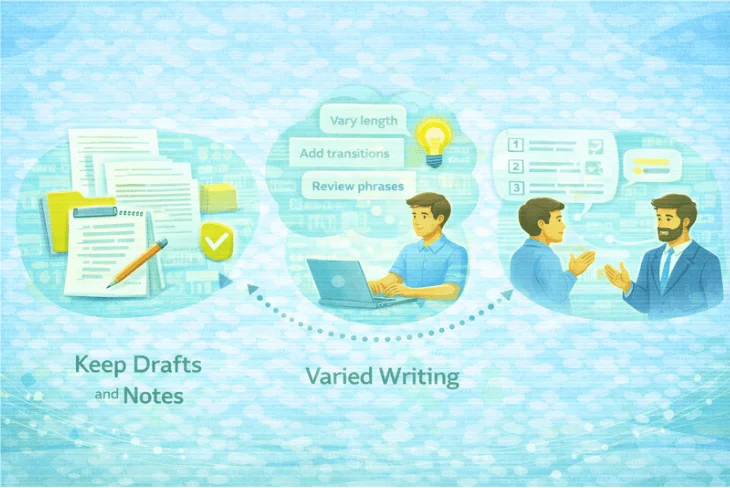
Avoid rushing to rewrite just to “beat” the AI score, since unnecessary edits can sometimes make your text appear more uniform and actually raise the percentage.
You can also review the text yourself for any areas that might unintentionally resemble AI patterns, like overly uniform sentence structures or repeated phrasing.
Simple humanizing steps—such as varying sentence length or adding natural transitions—can help, but focus on clarity and your own voice rather than trying to manipulate the score.
Finally, be ready to explain your process. If your instructor has questions, calmly describing how you wrote and revised your essay usually carries more weight than the AI percentage alone.
These steps give you control over the situation without causing extra stress.
Using a Reliable Turnitin Detector Before Submitting
If you’re looking for extra reassurance before submitting your paper, Turnitindetector offers a helpful preview of how your work might be assessed. It helps you catch potential issues before the final submission, so you can submit with confidence.

Key Benefits:
Accurate Turnitin Similarity Check – Quickly identifies sections that may be too similar to other sources, giving you a clear picture of how your work compares.
AI Content Detection – Helps spot content that might have been generated or influenced by AI tools, showing you exactly what your professor would see.
No Risk of Submission – Your paper isn’t stored or submitted anywhere, so you don’t have to worry about your work being saved in any database.
With Turnitindetector, you get a trustworthy preview, giving you peace of mind before submitting your final draft.
This approach gives you insight into your text while keeping your writing authentic and ready for official submission.
Conclusion:
Your essay didn’t magically become AI-written just because you removed images. What likely changed was how Turnitin processed and interpreted the same text.
The AI percentage is a signal, not a verdict, and formatting shifts can influence it more than most people realize.
Your best next step is simple: stay calm, keep evidence of your writing process, and be ready to explain how you worked. Understanding the report matters far more than chasing a perfect score.