
Turnitin Shows 35% Similarity in Thesis: What Should I Do?
After checking your thesis on Turnitin, you noticed a 35% similarity score, with references contributing about 10% and most matches pointing to works you cannot access.
I get why this feels stressful—seeing hundreds of flagged sources without details can make you question whether your writing is safe.
This section will clarify what your report really represents and introduce key concepts you need to interpret it accurately.
Understanding these basics sets the stage for seeing why the score may look higher than expected and how to approach it.

Quick Answer to "Why Is My Thesis Showing 35% Similarity?"
Direct Answer
A 35% or a 36% Turnitin similarity score doesn’t automatically mean your thesis has plagiarism issues.
References alone can account for a significant portion, and small matches to common phrases or previously submitted works often inflate the score.
Instructors usually examine what contributes to the score rather than the raw percentage, considering the context of each match.
Limited account access may prevent you from seeing many small similarities, which can make the report seem more alarming than it is.
TL;DR Bullets
References can contribute a notable part of the similarity score.
Many small matches are common and often not concerning.
Limited Turnitin accounts may hide most match details.
Minor edits to flagged sections can increase confidence.
Context matters more than the raw percentage.
This quick answer helps you see why the score isn’t necessarily alarming, but to make sense of it fully, you need to understand Turnitin’s core concepts.
Key Turnitin Concepts You Need for This Question
Understanding how Turnitin works helps you interpret your 35% similarity score and reduce unnecessary anxiety.
One of the main metrics is the similarity score, which represents the percentage of your text that matches content from Turnitin’s databases.
This includes previously submitted student papers, published works, and even your references.
In your case, references alone contributed roughly 10% of the total score, showing how standard academic citations can influence the number.
Another key element is the match list, which breaks down exactly where Turnitin found overlaps.
Limited accounts, like the one you used, may allow you to see the number of matches but not the detailed text or sources.
This can make the report feel overwhelming, especially when hundreds of small matches appear across multiple documents.
Exclusion settings are also important. Instructors can adjust Turnitin to ignore certain matches, such as small phrases, quotations, or the reference list.
This means that the official report your instructor sees may be much lower than what you view in your limited account.
Turnitin’s algorithms also consider the word-to-match ratio—longer passages with occasional matches generally have less impact on the final similarity score than many short, repeated phrases.
Finally, Turnitin detects exact matches as well as near matches, which include paraphrased text that closely resembles other sources.
Short common phrases, technical terms, or standard expressions often get flagged, but they are usually not a concern if the text is original and properly cited.
By knowing these concepts, you can better understand why a 35% similarity score may appear high even when your work is original.
Recognizing what counts toward the score, how matches are displayed, and what your instructor can exclude gives you a clear framework for interpreting your report and deciding whether any minor edits are needed.
Why the Score Can Look High Even for Original Work
Even if you wrote your thesis entirely on your own, Turnitin can flag many small matches that add up to a higher similarity score.
Short, common phrases, technical terms, or standard expressions often appear in other submissions and get counted toward your percentage.
For example, a single page could show 17 matches across 30 lines of text without any actual plagiarism.
Your references also contribute to the score, which is normal. In the scenario you described, references made up about 10% of the 35% similarity.
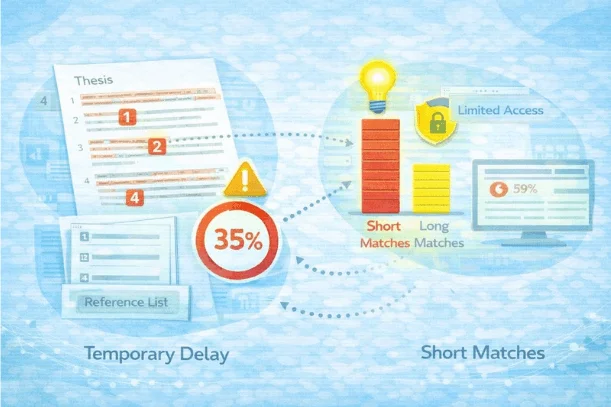
Limited account access can make the situation feel more alarming because you can see the number of matches but not the specific text, so hundreds of small overlaps appear without context.
Other factors include Turnitin’s word-to-match ratio, which considers how long each matching segment is.
Many short matches increase the similarity percentage faster than a few long matches, even if the text is original.
Understanding these mechanics helps you see that a high similarity score doesn’t necessarily indicate a problem.
Most of these flagged sections are minor, often unavoidable, and usually aren’t an issue for instructors reviewing your work.
Steps You Can Take Before Submitting
Now that you understand why your 35% similarity score might look high even for original work, you can take practical steps to bypass Turnitin.
Start by reviewing any sections flagged by Turnitin, focusing on repeated phrases or sentences that could be easily reworded.
Minor edits or paraphrasing can slightly reduce the similarity score without changing your meaning.

Properly formatting and checking references is another simple step.
Since references often contribute a significant portion of the similarity percentage, making sure they follow the correct style and are clearly separated from your main text helps prevent unnecessary matches.
You can also consider using a third-party Turnitin-style detector for a pre-check. These tools don’t replace the official report but can highlight areas with higher similarity so you know where to focus edits.
Finally, remember not to fixate on the raw percentage alone. Instructors usually review the context of matches, and small overlaps or common phrases rarely pose a problem.
Your goal is clarity and proper citation, not achieving a perfect numeric score.
Quick actions:
Paraphrase flagged phrases.
Double-check references.
Consider a pre-check with a third-party detector.
These steps give you control over minor issues and help you submit with confidence.
Try a Reliable Turnitin Detector
Since you may have limited access to Turnitin or want to check your work before the official submission, a reliable Turnitin alternative like Turnitindetector can be very useful.
A trusted detector like Turnitindetector can help you:
Get a Similarity Report – Quickly identify sections of your paper that may be too similar to other sources, giving you a clear preview before you submit.
AI Content Detection – It detects AI or AI-generated content, showing you exactly what your professor would see during their review.
No Database Submission – Your work is not stored or submitted to any repository, so it won’t affect your final submission’s similarity score.
By using Turnitindetector, you can feel confident knowing your paper is fully checked for similarity and AI content before you submit it officially.

They can help you identify areas to review or paraphrase, giving you confidence before submitting, but your instructor’s official Turnitin report is the final measure.
Using these tools strategically can make your pre-submission review more focused, efficient, and less stressful.
Conclusion:
Seeing a 35% similarity score can feel worrying, but much of it likely comes from references and short matches rather than plagiarism.
The key is context: instructors often exclude small matches and focus on meaningful overlaps. To feel confident, review flagged sections for clarity, ensure proper citations, and consider a third-party detector for a pre-check if you like.
Focus on what you can control—minor edits and accurate referencing—so you can submit your thesis with confidence, knowing the majority of matches are normal and expected.