
Fast Read: Is Turnitin AI or Just an AI Detector?

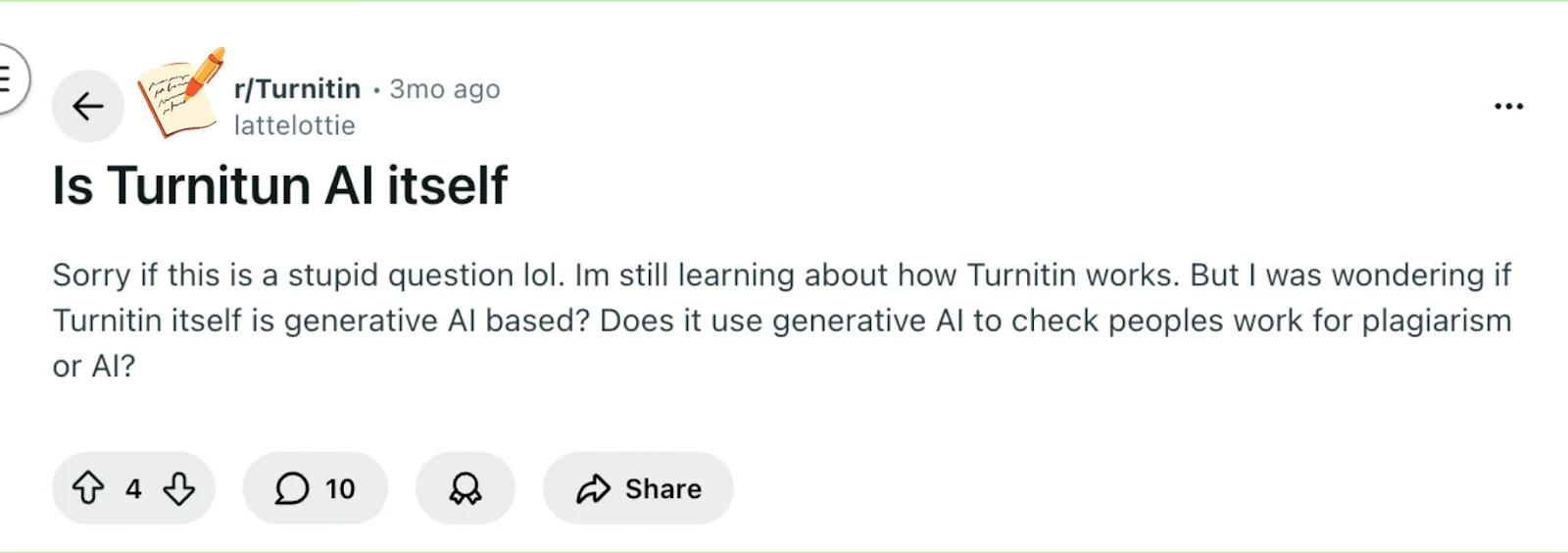
In a Reddit post, a student asked this exact question, unsure how Turnitin works and whether it uses generative AI.
Confusion often arises because Turnitin has multiple features—plagiarism checking, AI detection, and a submission database—that can all sound technical.
Understanding how these pieces fit together can help reduce anxiety and clarify what actually happens to your work. The first step is to get a clear, concise answer to the question itself.
Quick Answer to ‘Is Turnitin AI Itself?’
Direct Answer
Turnitin is not generative AI when it checks for plagiarism. Turnitin's main function is comparing your submission against a large database of previous student work, publications, and other sources. That comparison uses automated systems and pattern recognition, but it doesn’t create new text or rewrite your work. Turnitin’s AI detection is a separate feature that tries to identify patterns associated with AI writing, but it is not part of the core plagiarism-checking process. Essentially, Turnitin is an analytical tool rather than a generative AI.
TL;DR Bullets
Plagiarism checks compare submissions to a database.
AI detection is a separate tool analyzing potential AI-written patterns.
Generative AI produces text; Turnitin does not.
High AI scores indicate possibility, not certainty.
Your work is not being rewritten or shared automatically outside of the database.
This gives you a foundation for understanding the mechanics behind Turnitin, which leads us to the key concepts that clarify why it is not generative AI.
Key Turnitin Concepts You Need for This Question
Understanding whether Turnitin is AI itself requires knowing a few key concepts about how the platform works.
First, similarity matching is the core of Turnitin’s plagiarism detection.
When you submit a paper, Turnitin scans your text and compares it against a large database of previous student papers, academic publications, and other online sources.
Any overlaps are highlighted for your instructor to review, but the system itself does not rewrite or generate new text. This distinction is important because it separates pattern recognition from generative AI.

Second, the Turnitin submission database is where your paper may be stored after submission. Turnitin uses this repository to check future submissions for overlaps.
How long your work is kept or who can access it depends on assignment settings controlled by your instructor or institution.
These settings are crucial for understanding the limits of your control over your own work and whether it will be added to the database.
Third, Turnitin’s AI detection feature is separate from plagiarism checking.
This tool analyzes writing patterns to identify characteristics common in AI-generated text, often from large language models.
It provides a likelihood score rather than a definitive answer and can fluctuate because AI models constantly evolve. High scores indicate a possibility of AI involvement, not proof.
Finally, the difference between analytical AI and generative AI matters here.
Turnitin uses analytical AI techniques—like pattern recognition—to detect similarities and potential AI writing, but it does not generate new text, create feedback autonomously, or synthesize your work.
Understanding these terms helps clarify why Turnitin cannot be considered generative AI in its plagiarism-checking process, even if AI features exist alongside it.
Together, these concepts explain the mechanics behind Turnitin and help you separate fact from misconception when asking, “Is Turnitin AI itself?”
How Turnitin Plagiarism Checking Works
Now that you understand the core concepts, it helps to see how Turnitin actually processes your submission. When you upload your paper, Turnitin scans the text and compares it against several sources:
Student submissions stored in its database
Academic publications and journals
Online content, including websites and articles
The system identifies overlaps and similarities, then highlights these matches in a report. Importantly, Turnitin does not rewrite, generate, or modify your work during this process.
Its role is purely analytical: it shows potential matches so your instructor can review them and decide whether they count as plagiarism, a citation issue, or a false positive.
This process relies on pattern recognition rather than generative AI. The matches are presented as a similarity score and a match list, which gives you and your instructor a clear view of which parts of your paper overlap with existing content.
Understanding this mechanism is crucial because it explains why Turnitin is not generative AI—it doesn’t create or synthesize text, even though it uses algorithms to detect similarity. This distinction also sets the stage for understanding Turnitin’s separate AI detection feature.
Turnitin’s AI Detection Feature vs Plagiarism Checks
Having seen how plagiarism checking works, it’s important to understand the separate AI detection feature.
Unlike plagiarism checks, which compare your text to a database, AI detection analyzes the writing itself. It looks for patterns commonly found in AI-generated text, often from large language models, and assigns a likelihood score.
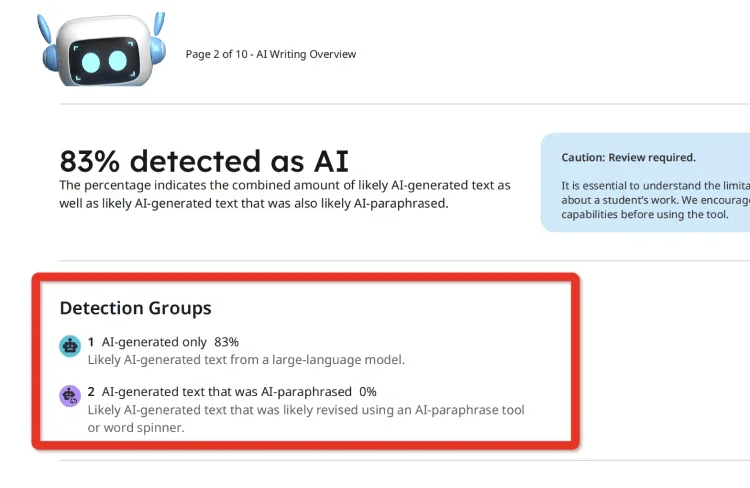
This score is not a verdict—it only indicates the possibility that AI may have been involved.
A few key points distinguish the two systems:
Plagiarism checking identifies overlapping text with existing sources.
AI detection examines writing style, sentence structure, and other linguistic features.
AI detection results can fluctuate because AI models are updated frequently, and no score can conclusively prove AI involvement.
Understanding this distinction helps you see why Turnitin is not generative AI. The system does not create, rewrite, or synthesize your paper—it simply analyzes patterns.
Recognizing that these are two separate tools—one database-driven and one stylistic—can reduce anxiety and clarify what each report is actually telling you.
Knowing how AI detection works naturally leads to thinking about what happens to your paper after submission.
What Happens to Your Paper After Submission
After you submit your paper to Turnitin, it is usually added to the submission database. This allows the system to compare future submissions against your work to detect overlaps.
How long your paper is stored and who can access it depends on assignment settings determined by your instructor or your institution.
In some cases, your submission may be stored permanently; in others, it may only be retained temporarily.
Turnitin does not use your paper to create new content, generate AI feedback, or share it beyond the system’s database.
Its primary function remains analytical—detecting similarities rather than producing or rewriting text.
Understanding this helps clarify why Turnitin cannot be considered generative AI, even though it has AI detection features.
A few practical points to keep in mind:
Your paper is part of a database that supports plagiarism checking.
Storage policies vary, so you may not control how long it remains.
Questions about alternatives or storage options should be directed to your instructor.
Knowing how your work is stored and used naturally leads to considering whether you can actually opt out of Turnitin storage.
Can Students Opt Out of Turnitin Storing Work?
After understanding how your paper is stored, you might wonder if you can prevent Turnitin from adding it to the database.
In most cases, storage decisions are controlled by your instructor or institution, not by students.
This means you may not have a direct way to stop your work from being included.
However, some instructors can choose assignment settings that prevent submissions from being stored permanently or allow alternative submission methods.
If you are concerned about your paper being stored, the most practical step is to talk with your instructor early.
You can ask whether your assignment has an option to bypass repository storage or if there’s an alternative submission method.
Keep in mind that these options vary widely, so it depends on your specific class and institution.
Key points to remember:
Turnitin storage is usually assignment- and instructor-controlled.
Students cannot universally opt out on their own.
Asking about alternatives or exceptions can clarify your options.
Bonus Tip: How to Use a Reliable Turnitin Detector
If you want to know your Turnitin score without having your paper stored by Turnitin, a reliable Turnitin detector like Turnitindetector is a great option.
Here’s how to use it:
Upload Your Paper – Simply upload your draft or final version to Turnitindetector.
Get a Similarity Report – The tool scans your paper and provides a detailed similarity report, showing you areas that may need revision.
AI Detection – Turnitindetector also checks for AI-generated content, helping you see exactly what your professor would see.
No Storage Risk – Unlike Turnitin, your paper is not stored or submitted to any database, so your final submission won’t be affected by previous checks.

Using Turnitindetector helps you assess your work before the official submission, giving you peace of mind without risking database storage.
Conclusion
It’s normal to feel anxious about Turnitin, AI detection, and what happens to your work.
The core takeaway is that Turnitin is not generative AI for plagiarism checks; it analyzes patterns and highlights similarities. AI detection is separate and only provides a likelihood, not proof.
Your best next step is to understand your assignment’s submission and storage settings and, if needed, talk with your instructor about alternatives.
By knowing how the system works, you can submit your work with more clarity and less stress.