
(Quick Guide) What Does Blue Mean on Turnitin Similarity?

You submit your assignment, open your Turnitin report—and see a blue similarity score.
So what does that actually mean? Is it good? Will it affect your grade?
A lot of the confusion comes from not fully understanding how Turnitin works or how instructors interpret the report. This guide breaks it down. You’ll learn what the blue score really means, when it matters, and how to read your report with confidence.
What Does Blue Mean on Turnitin Similarity Report
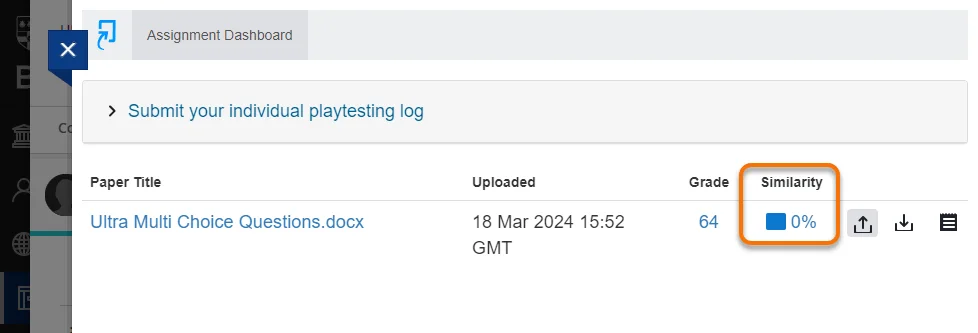
A blue result on Turnitin doesn’t always mean exactly the same thing. It depends on which Turnitin system is generating your report.
There are two common scenarios: Turnitin Feedback Studio (Originality Report) and Turnitin Similarity / SimCheck. Which one you see depends on which version your school has purchased.
Blue Score in Turnitin Feedback Studio Report
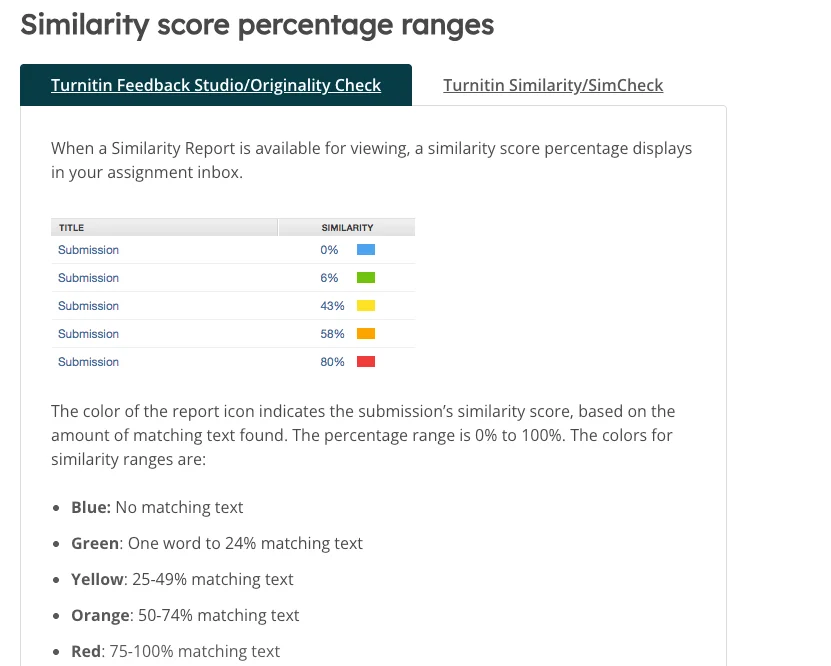
If your report comes from Turnitin Feedback Studio, blue typically means 0% similarity. In simple terms, Turnitin didn’t find matching text in its database.
That usually happens when:
Your wording doesn’t closely match existing sources
You’ve written independently rather than relying on copied or repeated phrasing
However, A 0% similarity score doesn’t automatically mean your paper meets all expectations. For research-based assignments, instructors usually look for clear citations and evidence that you’ve engaged with sources. So while a blue score generally indicates originality, it still needs to be interpreted in the context of your assignment requirements.
Blue Score in Similarity or Simcheck Report
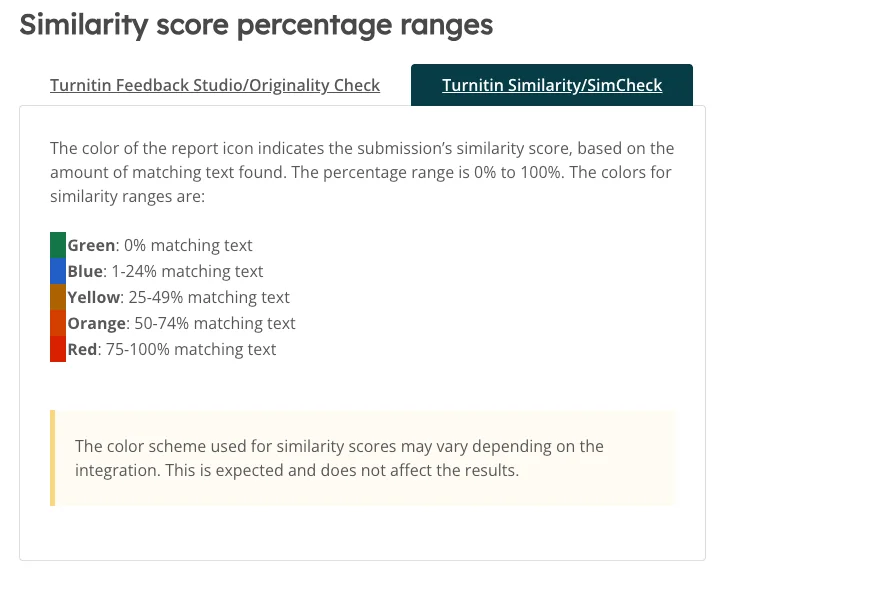
In Turnitin Similarity (SimCheck), blue usually represents a similarity score of 1%–24%, which is higher than in Feedback Studio.
Even so, this is typically considered a safe range. It often includes minor matches, such as:
Short phrases
Common academic language
Properly cited content
In most cases, this reflects normal writing rather than a problem.
What Blue Means Overall
No matter which Turnitin report you’re using, blue generally indicates a low similarity range.
However, that doesn’t guarantee a good grade. Your instructor will still evaluate your work based on the assignment requirements—especially how well you use and cite sources.
What Influences Your Turnitin Blue Similarity Score

As mentioned earlier, your Turnitin similarity score is shaped by several factors.
1. How you use sources
One of the biggest factors is how you incorporate sources into your writing. Turnitin identifies text overlap, so even properly cited material can still appear as a match in your report. That’s normal. What matters is how your instructor evaluates those matches based on the assignment guidelines. If you’re using sources correctly, it’s usually not an issue.
2. Paraphrasing quality
Paraphrasing plays a key role. If your wording is too close to the original source, it may still be flagged as similar. Strong paraphrasing—rewriting ideas in your own words while keeping the meaning—can help lower similarity while still showing you understand the material.
3. Quoted content
Direct quotes will almost always show up as matches, even when cited correctly. A few well-used quotes are fine, but overusing them can increase your similarity score.
4. Common phrases and academic language
Turnitin may flag commonly used phrases or standard academic wording. These are usually harmless and often fall within a low similarity range.
5. Turnitin settings (instructor control)
Your instructor can adjust settings that affect your score, such as:
Excluding references or bibliographies
Ignoring quoted material
Filtering out small matches or common phrases
Because of this, the same paper can produce slightly different similarity scores depending on the settings used.
6. Database matches
Turnitin compares your paper against a large database, including:
Student submissions
Academic publications
Web content
If your topic uses widely discussed sources or standard definitions, small matches are more likely.
What Blue Means to Professors and Its Direct Impact on Grades
We’ve covered what a blue Turnitin similarity score means. But what does it actually mean for your grade?
The short answer: there’s no direct, fixed relationship between a blue score and your final grade.
Standards vary by instructor and institution.
On Reddit, one idea comes up repeatedly: there’s no universal “safe” similarity score. What matters more is the type of matches, not just how many there are.
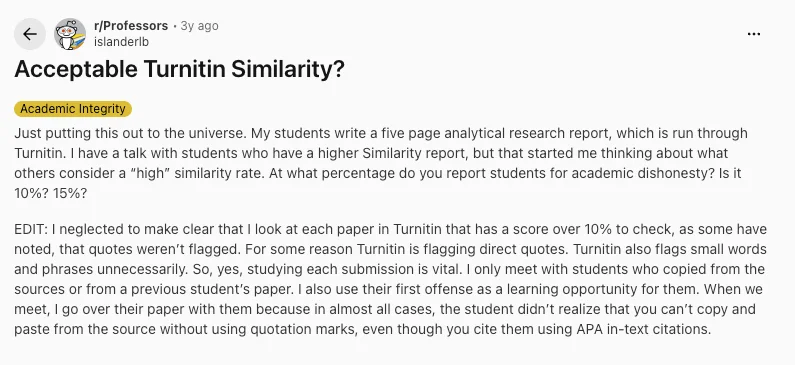
For example:
Properly cited quotes and common academic phrases may still appear in the report and are usually acceptable
Small matches from widely used sources are often expected in research writing
But even a low (blue) score can raise concerns if it shows weak paraphrasing or unclear citation
In other words, a blue score might reduce initial concern, but it doesn’t guarantee a high grade.
While this doesn’t reflect every professor’s exact standards, it’s a reasonable general takeaway. Most instructors tend to focus on:
How clearly your ideas are developed
How effectively you use and integrate sources
Whether your citations are accurate and consistent
Whether the writing shows your own understanding, not just reworded content
So, it’s fair to say: Turnitin is a tool—not a grading system. A blue score is a positive sign, but your grade ultimately depends on the quality of your writing and how well you meet the assignment requirements, not just the similarity percentage.
What Other Colors in the Turnitin Similarity Report Mean
If you’re also interested in the other colors, I’ve listed them below. Similarly, the meaning of each color may vary depending on which system your school has purchased.
Other Colors in Turnitin Feedback Studio
In Turnitin Feedback Studio, colors show increasing levels of similarity beyond blue.
Green (1%–24%)
Low similarity. Usually minor overlaps, often acceptable.Yellow (25%–49%)
Moderate similarity. May require a closer look at source use.Orange (50%–74%)
High similarity. A large portion of text matches existing content.Red (75%–100%)
Very high similarity. Most of the content overlaps with other sources.
Other Colors in Turnitin Similarity / SimCheck
In Turnitin Similarity / SimCheck, the same progression applies, but the scale starts differently.
Green (0%) → no matching text
Yellow (25%–49%) → moderate similarity
Orange (50%–74%) → high similarity
Red (75%–100%) → very high similarity
Does Turnitin Similarity Equal Plagiarism?
This is a common misunderstanding. Turnitin itself does not claim that similarity equals plagiarism.
In fact, the company has clarified this by renaming its report from the “Originality Report” to the “Similarity Report.” That change highlights an important point: Turnitin is a similarity detection tool, not a plagiarism judge.
It simply identifies matching text and presents it as data. It does not decide whether you’ve done something wrong. That judgment is made by your instructor, who reviews how those matches are used in context.
As mentioned earlier:
Properly quoted and cited material will still appear in the report—this is normal and expected
Common phrases or widely used academic language can also show up as matches
On the other hand, poorly paraphrased content—even with a low similarity score—can still raise concerns
So a similarity score is just a starting point. Plagiarism is about how you use sources, not just how much text matches.
FAQ
Is blue on Turnitin always a good sign?
In most cases, yes. It indicates low similarity. But it should still be interpreted in the context of your assignment and instructor expectations.
Should I aim for 0% similarity?
Not necessarily. For assignments that require research, some level of similarity is expected and appropriate.
Can I get a low score and still have issues?
Yes. If sources aren’t cited properly or ideas are not clearly attributed, problems can still arise—even with a blue score.
Do professors rely heavily on Turnitin colors?
It depends on your instructor—some pay close attention to similarity scores, while others focus more on how your sources are used and how your work reads.
Conclusion
Understanding what blue means on Turnitin is really about how you interpret the similarity report—not just the color.
As discussed, blue usually signals low similarity, but its meaning still depends on context, assignment type, and how sources are used. Looking only at the percentage can be misleading—you need to understand what the matches represent.
With this approach, your Turnitin similarity report becomes a useful guide, not just something to worry about.